About
I'm interested in making things that are meant to be used every day. A mug for morning coffee, plates for a shared meal. These are small, simple moments, but the objects at the heart of them can take on a lot of meaning over time.
I try to match that simplicity by keeping my forms straightforward and only leaving behind subtle traces of the handmaking process. I draw inspiration from minimal and geometric shapes of mid-20th century modern design, as well as purely functional commercial products of that era: mass-produced enamelware and restaurantware that were designed to withstand repeated use. I find it deeply satisfying to trace how each design choice came from a specific problem that needed solving. I then push certain features, like big, rounded rims and handles to offer a friendlier look. There’s a quiet playfulness in the way the exaggerated proportions look and feel in your hand. I like to think of them as objects designed for children, scaled-up for adult use.
If you're interested in connecting, please reach out via email or Instagram.
I'm interested in making things that are meant to be used every day. A mug for morning coffee, plates for a shared meal. These are small, simple moments, but the objects at the heart of them can take on a lot of meaning over time.
I try to match that simplicity by keeping my forms straightforward and only leaving behind subtle traces of the handmaking process. I draw inspiration from minimal and geometric shapes of mid-20th century modern design, as well as purely functional commercial products of that era: mass-produced enamelware and restaurantware that were designed to withstand repeated use. I find it deeply satisfying to trace how each design choice came from a specific problem that needed solving. I then push certain features, like big, rounded rims and handles to offer a friendlier look. There’s a quiet playfulness in the way the exaggerated proportions look and feel in your hand. I like to think of them as objects designed for children, scaled-up for adult use.
If you're interested in connecting, please reach out via email or Instagram.
I'm interested in making things that are meant to be used every day. A mug for morning coffee, plates for a shared meal. These are small, simple moments, but the objects at the heart of them can take on a lot of meaning over time. That's what drives my work. I try to match that simplicity by keeping my forms straightforward and only leaving behind subtle traces of the handmaking process.
I draw inspiration from minimal and geometric shapes of mid-20th century modern design, as well as purely functional commercial products of that era: mass-produced enamelware and restaurantware that were designed to withstand repeated use. I find it deeply satisfying to trace how each design choice came from a specific problem that needed solving. I then push certain features, like big, rounded rims and handles to offer a friendlier look. There’s a quiet playfulness in the way the exaggerated proportions look and feel in your hand. I like to think of them as objects designed for children, scaled-up for adult use.
If you're interested in connecting, please reach out via email or Instagram.
(INFLUENCES.)
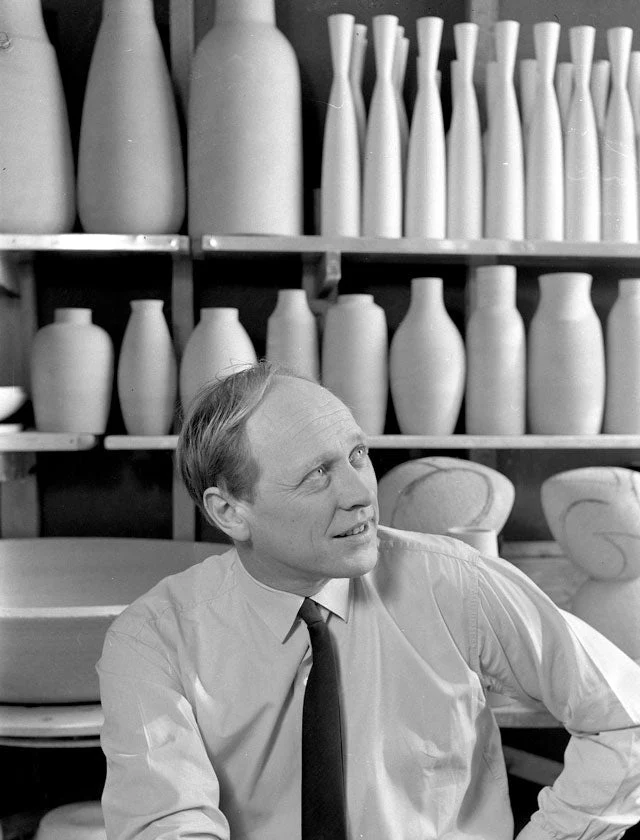
Carl-Harry Stålhane's WORK proved craft and industry don't have to pull against each other.

ULLA Procopé brought handmade softness into mass-produced tableware.

Maria van Kesteren's quiet forms showed how much can be said with very little.

HARRISON MCINTOSH found his style early on and stayed true to it his whole career.